Hockney’s wandering eye photos
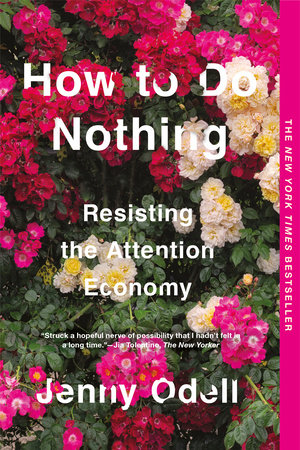
I started reading Jenny Odell’s book How to Do Nothing. I bought this book a while ago. I was browsing the book at Dussmann, opened a random page which happened to be page 96 and Odell was talking about David Hockney. I was sold.
I always remember Nick Hornby’s advice that in order to know if you like a book, you should open around page 80 and read.
Anyway, although I have too many books that I am reading right now, I still wanted to check that page about Hockney.
Odell wrote about Hockney’s approach to time through painting—that he thought the amount of time a painting takes to be painted is transferred to the viewer, and that photography lacks this quality of duration and is almost robotic in a sense.
She also wrote about Hockney’s polaroid photography work, where he took multiple photos of a scene from different angles and times, combining them to achieve a similar effect to human vision: how the gaze always moves, scanning and constructing the scene through time.
Odell quotes Hockney:
From that first day, I was exhilarated […] I realized that this sort of picture came closer to how we actually see, which is to say, not all at once but rather in discrete, separate glimpses, which we then build up into our continuous experience of the world […] There are a hundred separate looks across time from which I synthesize my living impression of you. And this is wonderful.
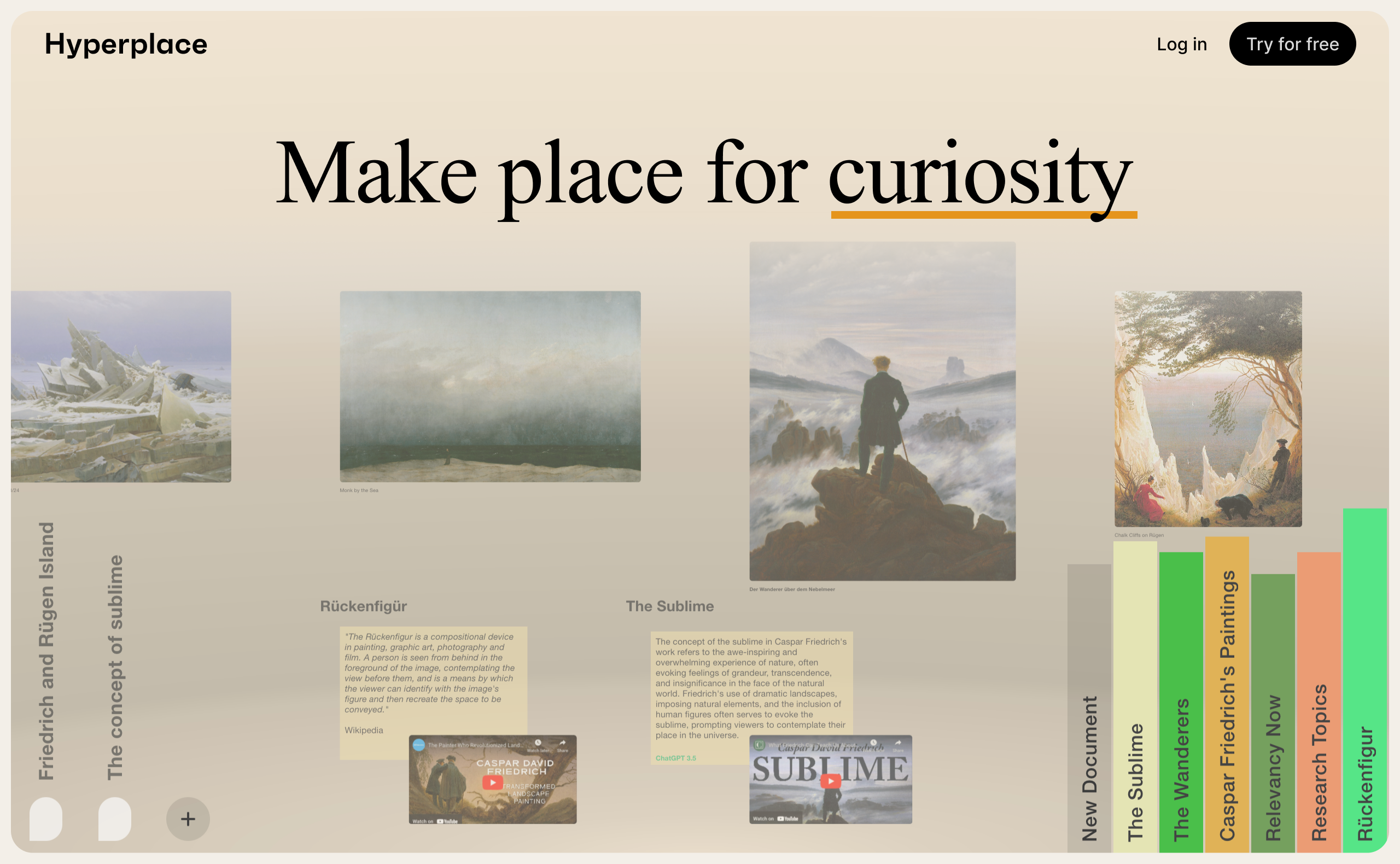
I was also thinking about this in regard to the wall in Hyperplace. Although I can pin lots of things on a wall, getting information from the pinned items at a glance is rather difficult.