Carrying a camera to pause more often
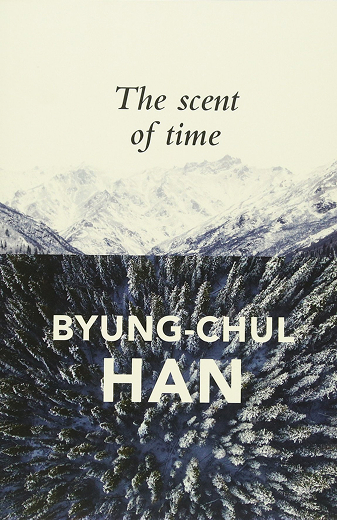
I was reading Byung-Chul Han’s The Scent of Time, and in the essay The Scent of Oak Wood he articulated something I had been feeling for some time. He argued that our time is defined by an acceleration of events, where one moment is immediately replaced by the next. He sees this as an expression of what he calls “the missing hold” — the absence of pauses that allow us to linger and stay with things. He concludes that without hold, we are adrift.
I recognized that feeling in my own movement through the city. I often pass by an interesting poster, a misplaced object, an unexpected patch of light, and hesitate to stop. Sometimes I am with someone, or on my way to meet someone. Sometimes I am moving within a crowd, and stopping feels inappropriate. Every once in a while, I pause just enough for a quick photo, but I rarely return to the photo and it disappears into my photo library.
I thought that taking a photo was a way of holding on, that otherwise the moment would pass. But while reading Han, I realized it was I who was passing. The moments revealed themselves at the precise place and time I happened to be there to see them, and I was the one failing to stop. I was adrift.
To hold on meant to “halt”, to stop and linger long enough notice what had stirred my interest. The moment was what mattered, not the thing itself. It was the opportunity for pause and contemplation that deserved to be cherished.
This, I think is what I want to achieve with photography. Photography gives me a reason to pause. Similar to the idea that reading with a pencil changes the way I read, I want to use photography as a tool to make my days more attentive. But that proved nearly impossible with my phone. Every time I picked it up, I drifted away from the moment and got lost in the device.
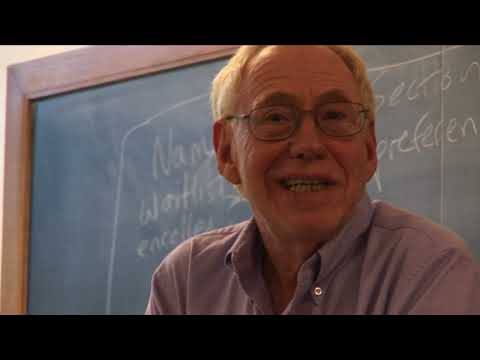
Through Hubert Dreyfus’s online lectures, I had been thinking about Heidegger’s philosophy of tools — how a good tool, in use, becomes almost invisible. Smartphones, by contrast, are designed to capture attention. I would often pick mine up for one purpose, get distracted by something else, and forget why I picked it up in the first place. That’s why my phone can never be that tool for me, and why I felt I needed a tool built for a single purpose.
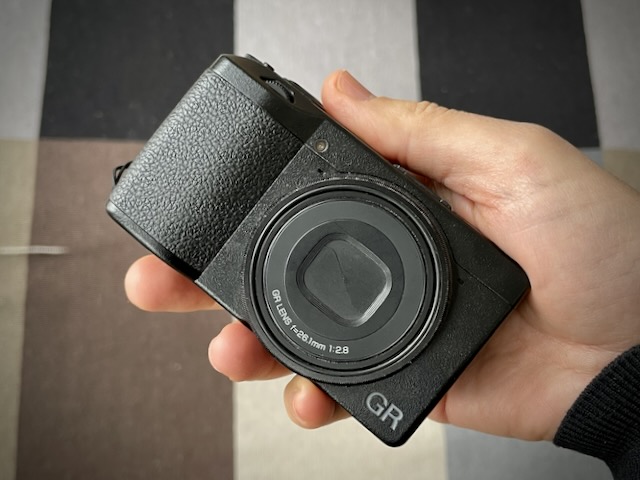
With that in mind, I finally decided to buy a Ricoh GR digital camera. I had read many reviews describing it as an ideal everyday camera, refined over decades for that purpose. When I discovered that each time I turned it off it displayed the number of photos taken that day, I knew I had made the right decision.
While photographing many memorable moments with my family, beautiful sunsets and sunrises, and countless details from my daily life in Berlin, something unexpected happened: the camera started to appear in my dreams. Sometimes, in my dream, I’d reach into my pocket and feel relieved that it was there; other times I’d find myself witnessing a beautiful scene and photographing it. I like to think the camera is not simply appearing in my dreams, but has the power to manifest these dreams—much like what I expect from it when I am awake.
For me, the purpose of the camera is no longer to “take” photographs, but to draw out the fleeting moments in ordinary days that deserve a pause.
My friend Aleks once said that, in those moments, instead of taking the photo, I could simply enjoy the moment. I’m still dwelling on that.
+
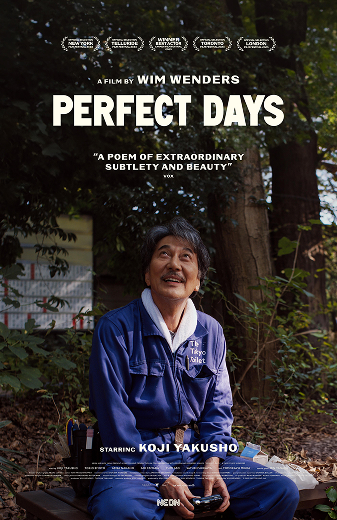
Hirayama, the main character in Wim Wenders’ movie Perfect Days carries a camera with him every day as well. Wenders captures those moments of pause more beautifully than I can put into words. It’s my favorite movie of 2025.